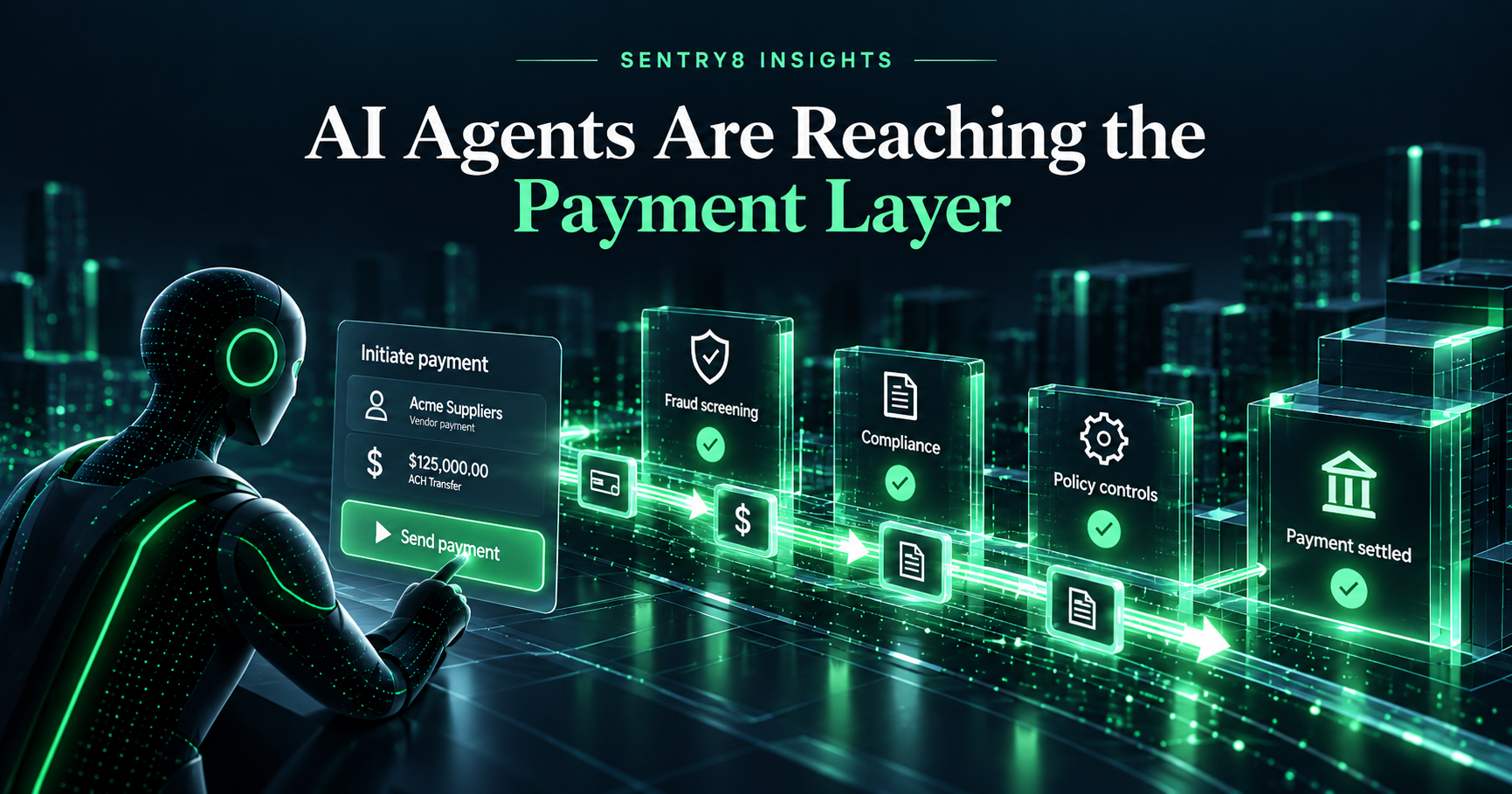
For years, AI in banking mostly helped people make decisions.
It detected fraud.
It analyzed transactions.
It supported customer service.
It helped employees process information faster.
Agentic AI changes that model.
The AI system can increasingly take the next step itself.
In payments, that could mean selecting when to pay, choosing a payment method, checking supplier terms and executing routine transactions without waiting for a person to perform every step.
Its September 2026 report explained that AI agents may eventually select payment instruments, payment timing and payment rails independently within a defined mandate.
That is a meaningful change.
Traditional financial controls were largely designed around human users and predictable software.
AI agents work differently.
They can interpret goals.
They can choose between different paths.
They can interact with several systems.
And they can do this at machine speed.
That creates enormous potential for efficiency.
It also creates a new type of operational risk.
Imagine an AI agent responsible for supplier payments.
Its task is simple:
Pay approved invoices while optimizing cash flow.
The agent identifies an invoice and decides that payment should be made today.
The invoice is legitimate.
The supplier is approved.
But the amount is unusually high.
Or the bank account was recently changed.
Or the payment violates an internal separation of duties rule.
Or the person who originally gave the agent authority no longer has the right to approve that transaction.
The agent may still be behaving logically.
The action may still need to be stopped.
This is why the move from AI assistance to AI execution requires a different kind of infrastructure.
NIST has already warned about agents receiving overly broad access and long lived credentials.
Its guidance points toward more granular authorization, stronger identity controls and better governance around what agents are actually allowed to do.
For financial institutions, this becomes even more important because execution has direct consequences.
A bad recommendation can be reviewed.
A bad transaction may already have moved money.
Sentry8 is designed for that moment.
It provides a control point before execution.
The system can evaluate an agent's proposed action according to the identity involved, the permissions granted, the relevant policy, the transaction context and any approval requirements.
The objective is not to stop AI agents from acting.
It is to create the conditions where they can act safely at scale.
As autonomous agents become part of financial workflows, this control layer is likely to become fundamental.
The future of financial AI will not only depend on how intelligent agents become.
It will also depend on how reliably institutions can control what those agents are allowed to do.