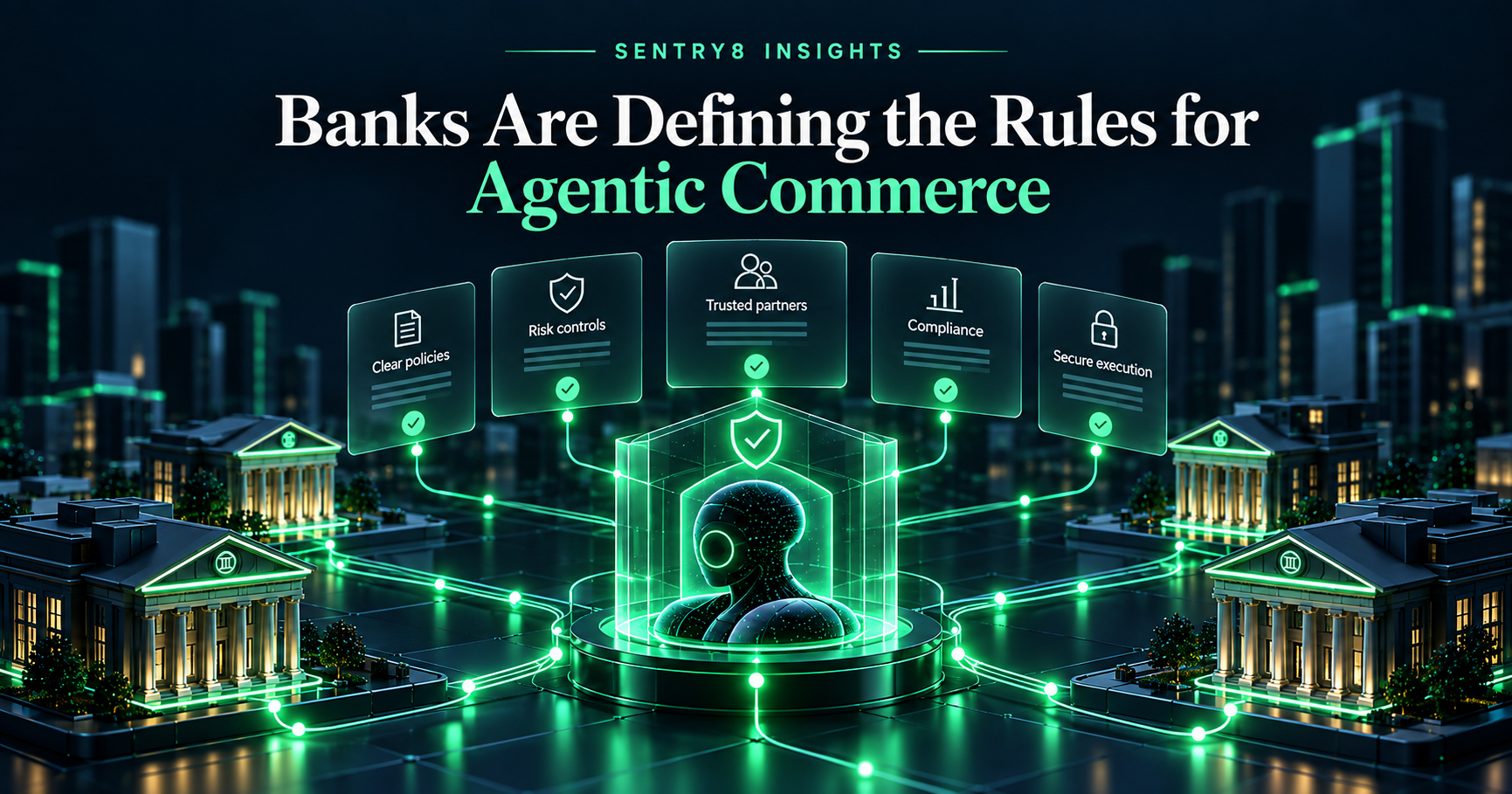
Agentic commerce is moving from an idea to something banks are actively preparing for.
In September 2026, six major banks published a shared set of principles for trusted agentic commerce.
The group included Bank of America, Capital One, Commonwealth Bank of Australia, ING, NatWest and ASB Bank.
Their involvement matters.
Banks sit directly between consumers, merchants, payment systems and financial infrastructure. If AI agents begin making purchases or initiating payments on behalf of people and businesses, banks will be one of the main places where the consequences appear.
The banks focused on five areas.
Transparency.
Safety.
Privacy and data.
Choice.
Interoperability.
These principles may sound broad, but they point to a very practical problem.
An AI agent cannot simply receive access to a financial system and then be trusted to make the right decision every time.
Consumers will want to know what the agent is doing.
Merchants will want to know whether transactions are legitimate.
Banks will need to know what authority the agent has.
And everyone involved will need to understand what happens when something goes wrong.
The participating banks highlighted some of these concerns directly.
Consumers may worry that an agent will buy the wrong item, spend too much or expose them to fraud.
Merchants may worry about disputes, chargebacks and losing visibility into the relationship with the customer.
These are not only AI model problems.
They are execution problems.
The model may understand the user's intention correctly and still attempt an action that should not be allowed.
A transaction may exceed a limit.
An agent may attempt to use the wrong payment method.
An approval may be missing.
A policy may have changed.
The transaction may technically be possible while still being inappropriate.
This is why agentic commerce needs a control layer around the point of action.
Sentry8 is built around that idea.
Before an AI agent executes a sensitive action, the action can be evaluated against identity, permissions, policy, context and approval requirements.
The action can then proceed, require review or be blocked.
The important point is that this does not mean a person needs to approve every action.
That would defeat much of the value of autonomous systems.
The better model is controlled autonomy.
Routine actions that fit established rules can continue automatically.
Higher risk actions can receive additional scrutiny.
Exceptions can be routed to a person when needed.
And the decision can be recorded for audit and accountability.
The banks are now helping define what trusted agentic commerce should look like.
The next challenge is turning those principles into controls that work during real financial execution.
That is where the infrastructure around AI agents becomes just as important as the agents themselves.